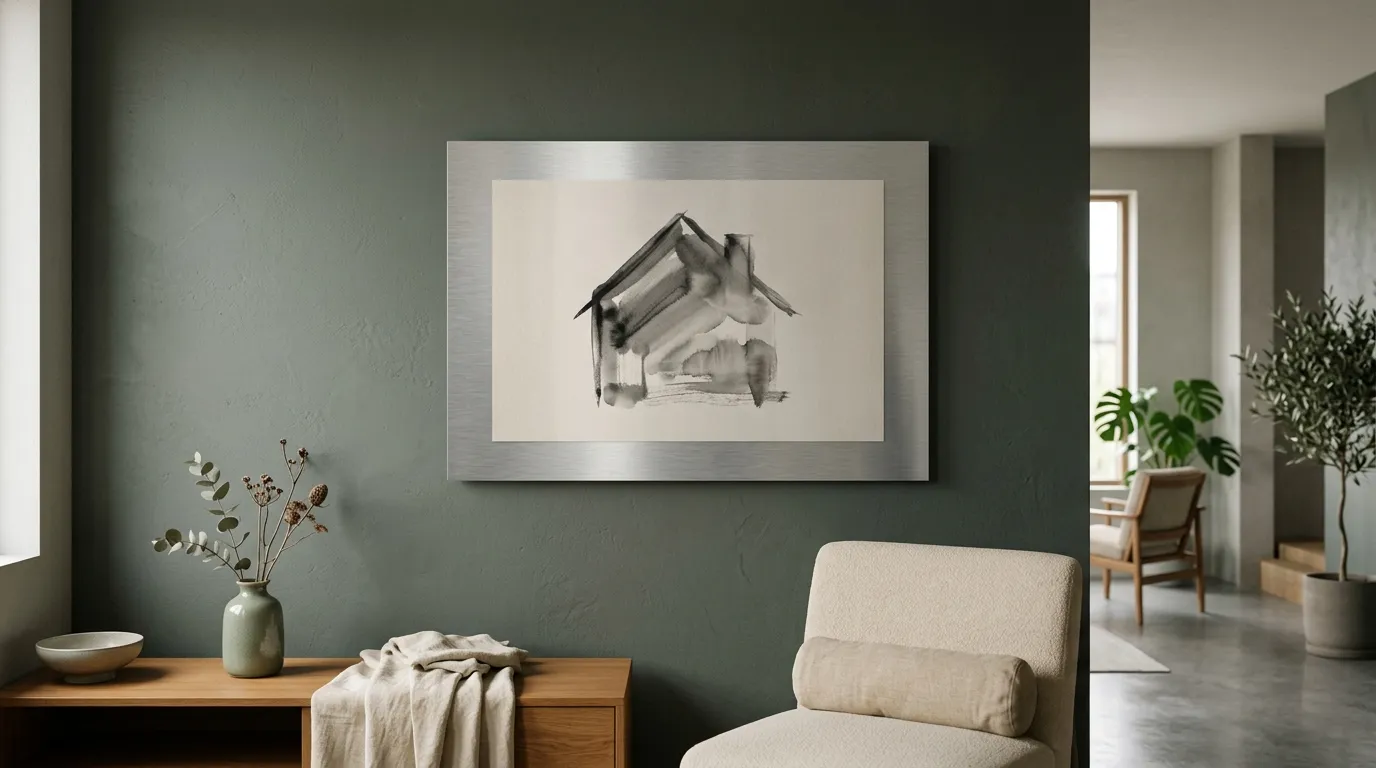
This is the one that reads as an object rather than as a picture somebody gave you, which is exactly why it suits the recipient who is uneasy about being given art. It's also the answer for a wall that's opposite a window.
No glass, and why that matters
Glazing is what ruins a framed print in a bright room. Put one on the wall facing a south-facing window and half the day you're looking at the window rather than at the house. There's no glazing here at all: the image is on the surface of the panel, so the only thing you see is the picture.
The panel is 3 mm. That's rigid enough to sit flat against a wall without bowing, and thin enough that it doesn't dominate a small one.
Which styles suit it
The hard, graphic ones. Fine line and blueprint are the natural fit, because a crisp edge on a hard surface is what the format does best, and both read as a drawing rather than as decoration. Bold ink and screen print work for the same reason. The softer styles, watercolour and pen and wash, are usually happier on paper, where the texture of the stock is doing half the work.
The three sizes
30x40 cm for a study, a small wall or a workshop. 40x50 cm as the middle option. 50x70 cm where the wall can take a proper piece. All three carry the same illustration from the same photograph, so the decision is only about the room.
How the picture gets there
What we need is a single daylight photograph of the front elevation, taken square on rather than at an angle. Then comes the style, and there are eight: fine line, soft watercolour, bold ink, blueprint, pen and wash, screen print, evening light and charcoal. Each one is rendered as a watermarked preview that costs nothing to look at, and the metal is printed only after you've approved the picture. No lettering goes anywhere near it: no name, no date, no address. If the photograph is already what you want on the wall, have it printed as it is, and if you'd rather not commission anything at all, sixteen houses have already been painted.
This sits in on the wall. The other formats are the canvas, which also needs no frame, and the framed print, which does use glazing and is the better answer away from direct light.