How to use it
Measure the length and width of the floor and the height of the walls, in metres. For wallpaper, copy the roll length, the roll width and the pattern repeat from the label. Rolls are not all the same size, so do not guess them. For paint, the boxes start with the figures Dulux prints for its Dulux Matt. Change them to the ones on your own tin.
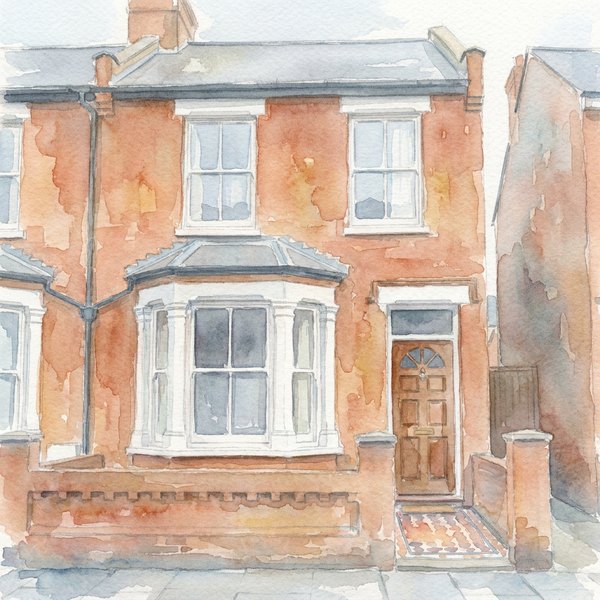 The House Illustration From £19.99
One photograph of the front of the house, restyled into an illustration. The watermarked preview is free.
How the wallpaper sum works
We measure the distance round the room and divide it by the roll width to get the number of strips. Graham & Brown advises not taking off doors and windows, so the spare covers mistakes, and we follow that. Each strip is the wall height plus 10 cm for trimming, 5 cm at the top and 5 cm at the bottom. That allowance is ours.
With a pattern, each strip is rounded up to a whole number of repeats, so the pattern lines up. For an offset (half-drop) match we add half a repeat to every strip, our allowance for lining up every other one. Then we count how many whole strips fit on one roll, because a short offcut is waste, and divide. Graham & Brown also advises allowing an extra 10% for waste, so we show that figure too.
How the paint sum works
The wall area is the distance round the room times the height, less any doors and windows you type in. Add the ceiling if you tick it. Then area × coats ÷ coverage gives the litres, and the litres divided by your tin size, rounded up, gives the tins. A tin's coverage is often given as "up to", the best case, so a rough or thirsty wall can take more.
Sources
- Graham & Brown, How to measure for wallpaper: ignore doors and windows, allow an extra 10%, the three match types. Read 30 October 2026.
- Dulux, Dulux Matt: coverage up to 14 m² a litre, 2 coats, sold in 2.5 litre tins among others. Read 30 October 2026.
When the walls are done, the room needs something on them. A picture of your own house is a good start, and our guide to hanging it covers the rest.